Building Connections: House Collective at Mill Tye Gallery

What happens when young people are given the space to shape their own creative journey—and then invite others to become part of it?
Over the weekend of 10 and 11 October 2026, Mill Tye Gallery became a meeting place for art, nature, food, making and community, welcoming House Collective for a programme created in partnership with Gainsborough’s House and Suffolk Wildlife Trust, as part of the Festival of Nature.
The weekend brought together six months of creativity, collaboration and learning. A display of artwork inspired by explorations of the local area, drop-in screen printing and the Field & Table gathering offered visitors opportunities to explore, make, share food and exchange ideas.
At the end of the weekend, our photographer Jacqueline Mellor spoke with Jilly Roberts, Learning & Engagement Curator at Gainsborough’s House, and Rowan Collinson, one of its Print Workshop Technicians, about how House Collective began, what the experience had meant to them, and the connections made through working with Mill Tye Gallery.
A space shaped by young people
House Collective began in April 2026 as a way to bring more young people into the life of Gainsborough’s House.
Designed for 16–25-year-olds, it offers opportunities to learn how a museum works, help shape events and workshops, and explore art and heritage alongside others with shared interests.
For Jilly, the starting point was creating “a space that is for them, by them”.
The first members came together through existing connections with the museum, including volunteering and the Print Workshop. They began discussing what they wanted to do, choosing the collective’s name and developing its logo.
That ownership matters. Members bring their own ideas and interests, helping to shape the direction of the programme as it develops. Previous experience is less important than enthusiasm, commitment and a willingness to learn.
Exploring local places, materials and ideas
The artwork on display grew from House Collective’s explorations of the local area, including visits to Bulmer Brick Yard and the Roman Villa at Gestingthorpe.
These experiences gave members opportunities to explore local heritage and materials, developing their own creative responses. The exhibition brought these together alongside work made through workshops with local artists and makers Raphaella Pester and Ned Davies.
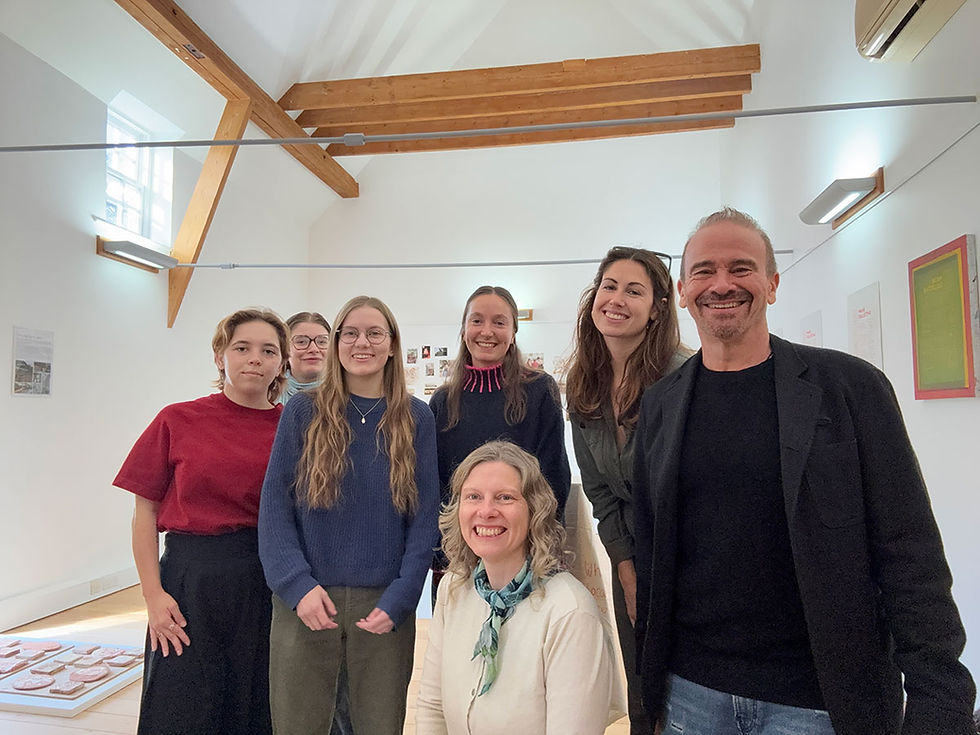
For Jilly, one of the weekend’s highlights was seeing the collective together at Mill Tye Gallery, with six months of collaboration realised in a gallery setting—including the bricks and tiles that had become part of their creative journey.
Alongside the displayed work, activities brought the process to life. Visitors could meet the people behind the project, ask questions and take part themselves.
Jilly spoke warmly about the contributions of Florence Cameron, Learning & Engagement Assistant at Gainsborough’s House, and Rowan to managing the weekend, welcoming visitors and delivering an experience that reflected House Collective’s commitment to supporting local people and representing the community they belong to.
An invitation to join the story
Rowan particularly valued the opportunity to share work that might otherwise remain within a workshop.
“It’s nice to give people an opportunity to showcase what they’ve been up to and invite people into that process,” Rowan explained.
Screen printing became one way to extend that invitation.
While visitors to Mill Tye may be familiar with lino printing, the weekend offered a chance to experience another printmaking process, with people of different ages having a go and taking their work home.
The screen-print design drew on the collective’s manifesto and the motif of a tile. Its symbols represented different members through their work and interests: individual contributions brought together within a shared design.
An empty tile left room for visitors to add something of their own.
That small space carried a generous idea. Anyone taking part could contribute to the artwork and become part of its continuing story.
As Rowan described it, House Collective is “a collection of people and experiences”—building together, much like the bricks of a house.

Field & Table: sharing food and conversation
The connection to local landscapes continued through Field & Table, a gathering on Saturday afternoon that invited people to share food, conversation and ideas.
Contributions came from Biddles Bread, which provided baked goods; The Little Dip Company, which supplied dips; and Stoke Farm Orchards, which provided beverages.
Together, they offered a starting point for exploring where our food comes from and how landscapes, traditions and communities shape what we eat.
In our conversation with Rowan, the relationship between food, craft and creativity emerged as another thread connecting the weekend’s activities. Baker Dominic Biddle’s background in community theatre prompted reflections on the different ways making and sharing can bring people together.
His story revealed how different creative practices can share a common purpose: creating opportunities for people to meet and connect.
These local contributions helped connect the exhibition’s ideas with everyday experiences—through what we make, the stories we share and the food we gather around.

A partnership with room to grow
For Peter, the weekend reflected one of the ambitions behind establishing Mill Tye Gallery: giving emerging artists opportunities to share their work, reach new audiences and take steps towards a career in the arts.
Reflecting afterwards, he wrote:
“It’s about creating opportunities for emerging artists to showcase their work, connect with new audiences and take those important steps towards building a career in the arts.”
Following Pulling Prints in March, House Collective continued a partnership with Gainsborough’s House that is creating opportunities for young and up-and-coming artists.
For Florence and Rowan, this also built on a personal connection with Mill Tye Gallery. Both are young artists who have previously shown their work here as part of Pulling Prints, and Rowan has also held a solo exhibition at the gallery.
Returning to help share House Collective’s work added another chapter to that relationship, bringing their experience as exhibiting artists into their roles supporting others to make, explore and connect.
Peter praised the care and professionalism that Jilly, Florence and Rowan brought to planning and delivering the programme, from the exhibition and shared meal to Sunday’s screen-printing workshop.
For him, the weekend demonstrated what organisations can achieve through a shared commitment to new creative talent—and offered a foundation for developing the partnership further.
Looking behind the scenes—and ahead
Beyond this exhibition, House Collective also gives members access to the working life of a museum.
Jilly described a previous visit to an exhibition before its labels had been installed, when members gained an insight into the curatorial process. Experiences like these help build an understanding of museum roles, heritage and the work that happens behind the scenes.
The group plans to continue meeting monthly, with further opportunities to explore exhibitions and develop future projects.
At Mill Tye Gallery, we were delighted to provide a setting where this part of their journey could be shared. Working in partnership created space for young people’s ideas to be seen, heard and experienced, while inviting visitors to contribute their own creativity and perspectives.
Across the weekend, the exhibition became a meeting place, with every conversation and contribution adding to the story.
Our thanks to Jilly, Rowan, Florence and everyone involved in House Collective, to our partners Gainsborough’s House and Suffolk Wildlife Trust, to the artists, makers and local producers who contributed, and to all the visitors who joined us.
HOUSE COLLECTIVE are:
Nelly Belcher
Flo Cameron
Rowan Collinson
Jacob Gaukroger
Kitty Fowles-Smith
Solo Nichol
Lucy Perry
Paulina Woznica
Mae Warner
Jess Williamson